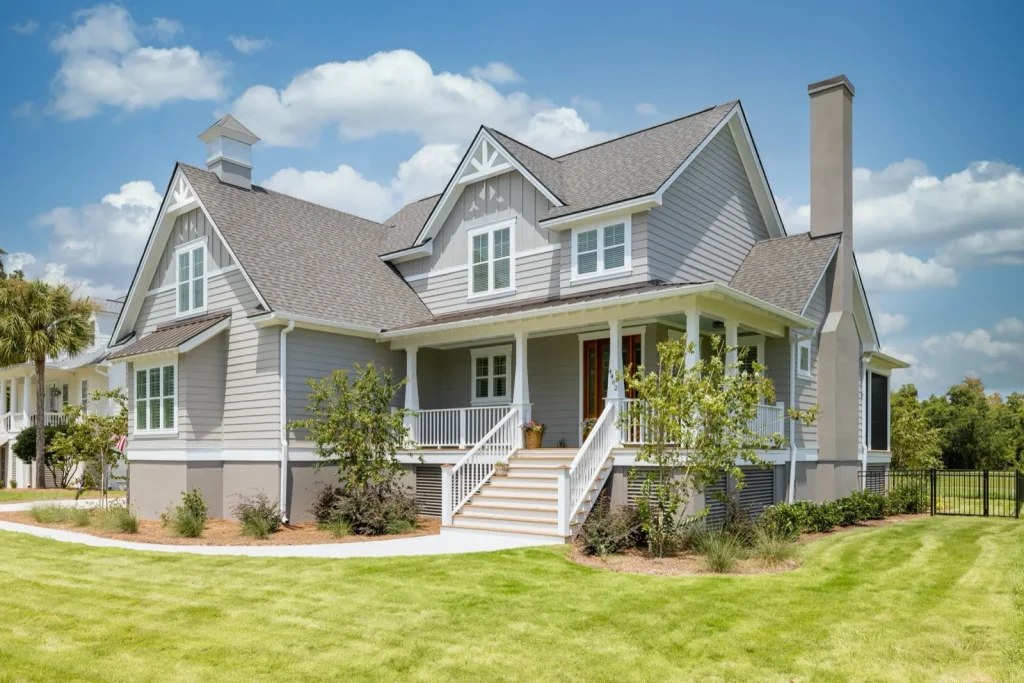
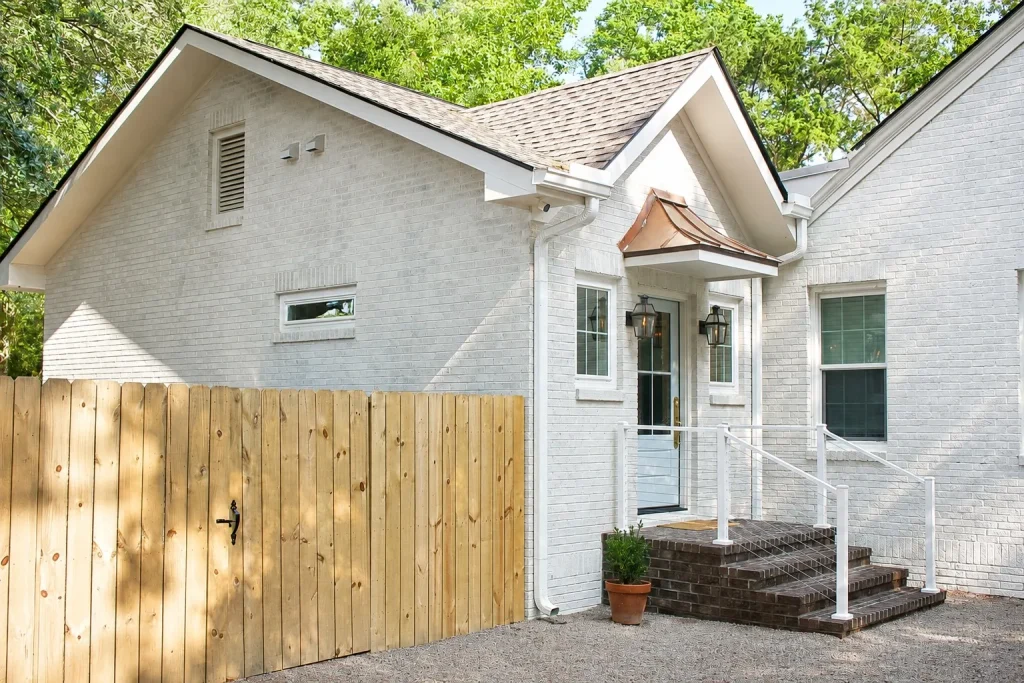
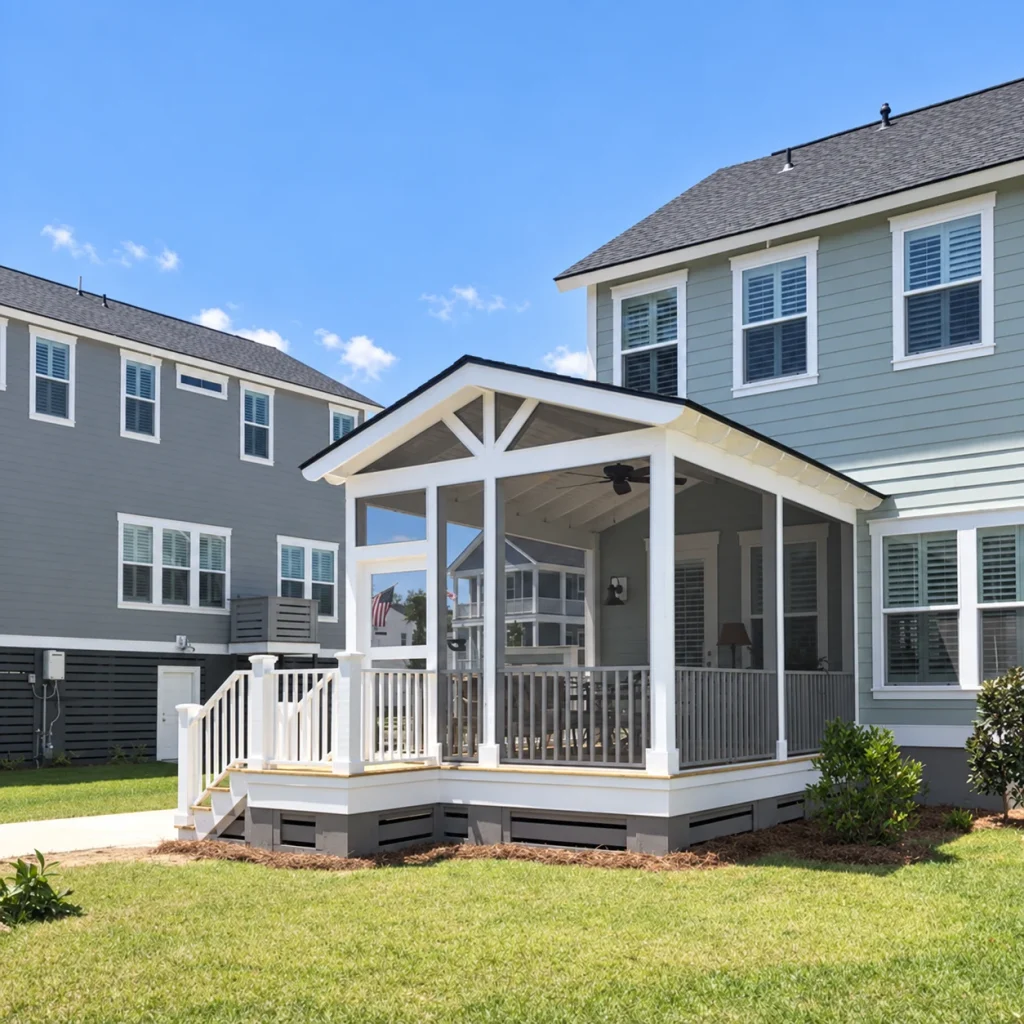
South Carolina’s building scene is really three scenes. The coast builds for salt, wind and flood elevations, from Charleston’s historic peninsula to the gated sea islands to the Hilton Head corridor. The Midlands build around Columbia’s lakes and suburbs. The Upstate builds on Greenville’s hills, from downtown infill to Lake Keowee’s shoreline — different climate, different soils, different craft traditions. A builder can be superb in one scene and merely competent a hundred miles away, which is the honest reason a statewide “best of” list should tell you where each firm actually lives.
This shortlist pulls the firms we would point a friend toward in each region, presented in no particular order. The first entry is us; the author regrets nothing. Service areas and claims come from each firm’s own published information.
1. Peartree Homes — Charleston (Lowcountry)
For the Charleston coast, Peartree is the full package in one firm: award-winning custom homes and whole-home remodels, kitchens, bathrooms and additions, built on fixed-price contracts by an in-house design-and-construction team. The record since 2012 includes five PRISM Awards (2022–2025) and consecutive first-place Best of the Holy City wins in 2025 and 2026 — earned on the peninsula, in West Ashley, and across James Island, Johns Island, Folly Beach, Kiawah and Seabrook. Every project runs through a 24/7 client portal with daily photos, and the company’s standard is blunt: do it correctly the first time. For out-of-state buyers building a Lowcountry home from a distance, that visibility is worth as much as the trophy shelf. Charleston
2. Classic Remodeling & Construction — Johns Island (Lowcountry)
For pure renovation pedigree on the coast: roughly thirty years of kitchens, baths, whole-house remodels, additions and ADUs across greater Charleston, with a national-caliber certification list — Certified Graduate Remodeler, Chrysalis Award, Qualified Remodeler Top 500 — that few firms anywhere in the state can match.
3. Structures Building Company (Alair Charleston | Structures) — Mount Pleasant (Lowcountry)
Custom homes and significant remodels around Charleston, Mount Pleasant, Daniel Island and the islands, with PRISM recognition spanning luxury single-family work, customer service and even a Habitat for Humanity build — range that says as much as the awards do.
4. Buffington Homes South Carolina — Johns Island / Kiawah (Lowcountry)
Thirty-plus years of sea-island custom homes with the national hardware to prove it — a Best in American Living Award among others — focused on Kiawah and its neighbors, with renovation work alongside new builds. The specialist’s choice for the gated islands.
5. Dillard-Jones Builders — Greenville (Upstate)
The Upstate’s marquee custom builder, based in Greenville with work reaching Lake Keowee, the mountains and the coast — the firm describes serving the Carolinas from Greenville to Charleston to the Hilton Head area. By its own count, more than 250 industry awards across 750-plus homes, and it runs a dedicated renovations-and-service arm as well, which is rarer than it should be at the luxury end.
6. Shoreline Construction — Bluffton (Southern Lowcountry)
Founded in 2006 and based in the Hilton Head/Bluffton corridor, Shoreline builds custom homes and handles remodeling and additions across Palmetto Bluff, Hampton Lake, Hampton Hall and the surrounding communities — and built Southern Living’s 2014 Idea House at Palmetto Bluff, which remains a fair one-line portfolio review.
7. Schumacher Homes — statewide
A different model from everyone above: a multi-state build-on-your-lot custom builder with South Carolina design studios in Charleston, Columbia, Greenville–Spartanburg and the Hilton Head–Savannah area, each serving roughly a 75-mile radius. For owners with land in hand who want a structured plan-and-build path rather than a boutique process, it is the volume route into a custom home — and its county-by-county coverage reaches parts of the state no boutique firm serves.
How the three South Carolinas build differently
The coast engineers for weather first: wind-zone framing and fasteners, flood elevations that put living space a full story in the air, and a corrosion environment that dictates everything from nails to door hardware. Coastal budgets carry those requirements whether the house is modest or magnificent, and coastal schedules carry design review in the communities that have it. The Upstate builds on topography: sloped lots, basements and terraced foundations that coastal builders rarely touch, mountain and lake microclimates, and a craft tradition shaped by brick and hardwood rather than cedar shake and piling. The Midlands sit between — lake frontage around Murray, suburban acreage, clay soils with their own foundation opinions. None of this makes one region’s builders better; it makes them specialized, and the specialization is exactly why the “hire where they build” rule earns its keep.
Choosing across a whole state
The honest rule: hire where the builder actually builds. A coastal firm knows wind zones, flood elevations and salt-air materials; an Upstate firm knows slopes, basements and mountain weather; neither expertise travels automatically, and your project should not be anyone’s field trip. Match the firm’s home territory to your lot, then apply the universal tests — license lookup with the state boards, past clients at the one-year mark rather than the walkthrough, finished projects you can stand in, and a contract whose risk allocation you actually understand. If you are relocating to South Carolina and building from afar, add one more filter: communication systems built for distance, because a beautiful house you could not watch being built is a stressful way to arrive in a new state.
How to read builder credentials across a state
Statewide shopping means comparing firms that brag in different dialects, so here is a translation guide. Licenses are the floor, not a distinction — verify and move on. Industry awards mean more when they are juried and project-specific: the Lowcountry’s PRISM Awards and their Upstate equivalents recognize actual built work, which beats directory badges that measure marketing diligence. Platform honors — the Houzz ecosystems and their kin — signal client satisfaction and curb appeal at scale, useful but self-reported in places. National recognitions, from Best in American Living to magazine idea-house commissions, suggest a firm performing at an above-market level. Certifications tell you about culture: remodeler and green-building credentials indicate a firm that invests in craft education. And tenure is the quiet credential — decades in one demanding market is a track record no trophy shelf can fake. Weigh them all, then let finished projects and year-old references outvote everything.
Building in South Carolina from out of state
A large share of the state’s custom work is commissioned from somewhere else — relocators, second-home buyers, retirees heading to the coast or the lake — and distance changes what to optimize for. Communication systems jump to the top of the list: daily photo documentation, live schedules and budgets, and written decision trails turn a long-distance build from an act of faith into a watchable process. Local fluency matters double, because you will not be at the county counter or the review board meeting — your builder is your presence. Time your visits to the build’s truth-telling moments, pre-drywall above all. Expect the climate conversation your home state did not require: coastal wind and flood engineering, or Upstate slope and soil work, each with budget lines that surprise newcomers. And give the design phase the patience distance demands — changes are cheap on paper and expensive at the end of a seven-hour drive. The firms on this list all build for distant owners routinely; make them show you how.
Signature projects, region by region
Each South Carolina region has a project type it has refined into an art, and matching your brief to the local specialty pays. The Charleston coast’s signatures are the elevated custom home — living space a story up, engineered for wind and flood, detailed for salt — and the historic-fabric renovation, where character preservation meets systems replacement. The sea islands refine the review-board custom home, built to community standards under maritime oaks. The Bluffton–Hilton Head corridor has made the golf-and-marsh community home its own, with Palmetto Bluff’s idea-house pedigree setting the tone. The Upstate’s signatures run to the sloped-lot custom home — basements, terraces, mountain views — and the lake house, from Keowee’s deep water to Hartwell’s coves. And statewide, the build-on-your-lot model serves the land-first buyer wherever the boutiques do not reach. A builder practicing its region’s signature project brings pattern knowledge no generalist can fake: the firms on this list are on it precisely because their portfolios read like their regions’ greatest hits.
Seven questions that work on any builder in the state
Regions differ; good vetting does not. Wherever in South Carolina you build, these seven questions sort the field. May I have your license number? — then verify it, because the two-minute check filters more than an hour of charm. What have you built within twenty minutes of my lot in the last three years? — recency and proximity beat volume. Fixed price or cost-plus, and exactly how do changes get priced? — the contract model is the experience model. Who runs my site daily, and how many projects do they carry? — meet the person, not the brochure. What will I see and hear each week? — the communication mechanism, not the intention. May I call clients from a year ago? — the settling year is the honest reference. And may I walk a current jobsite? — ten minutes of Tuesday truth. Any firm on this list will pass these questions comfortably; the value of asking is watching how they answer. Specific, unhurried, documented answers are the sound of a company that runs projects the same way.
One final statewide truth: the common thread among every firm on this list — coastal, Upstate or statewide — is that they make verification easy. Licenses offered, references current, jobsites open, contracts legible. That transparency is not a courtesy; it is the business model of companies that expect to be checked and have nothing to fear from it. Make it your minimum standard wherever in South Carolina you build, and most of the industry’s cautionary tales become somebody else’s stories.
South Carolina is a wonderful place to build a home — three states’ worth of landscapes under one flag, each with craftspeople who have made its conditions their specialty. Find yours among them, verify everything, and build something worth the state’s long tradition of good houses.
Wherever you land, let the local specialists be local: the Lowcountry firms for the salt, the Upstate firms for the slopes, and the statewide model for the land nobody else serves. The map, in the end, is the best adviser in the state.
Frequently asked questions
There is no statewide answer, and distrust anyone who claims to be it. The best builder for you is the standout in your region whose portfolio matches your project — which is exactly how this list is organized.
Rarely. Regional expertise — coastal engineering, Upstate topography — is real, and local trade and permitting relationships compound it. The exception is a firm with a genuine, staffed presence in both places, not a willingness to drive.
Residential and general contractor licenses are public record through the state’s licensing boards and searchable online in minutes. Ask for the number; a confident firm volunteers it.
Yes — remodeling is core business for several, ourselves and Classic Remodeling especially, with Dillard-Jones running a dedicated renovations arm in the Upstate. If your project is a renovation, weight the firms whose weekly work looks like yours. Fine print, Lowcountry edition: this article is one builder’s opinion — ours; we are the first name on it — the order past that is meaningless, and no money changed hands. South Carolina is full of excellent builders who are not on this list. Verify, visit, and decide for yourself.